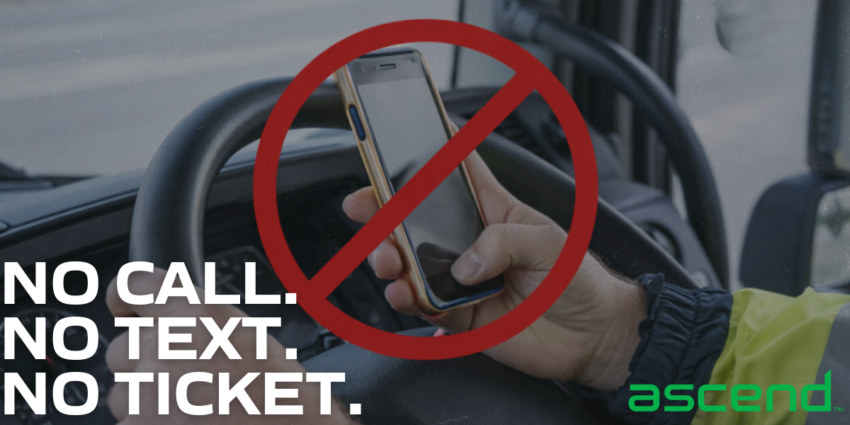
Staying Focused Behind the Wheel: Why Phone-Free Driving Matters
Post Date - Dec 22, 2025
At Ascend, safety isn’t just a policy — it’s how we take care of one another on the road. As professional drivers, you make thousands of decisions every day, often in fast-moving and unpredictable environments. One of the simplest ways to reduce risk and protect yourself, your livelihood, and those around you is by keeping your focus where it belongs: on the road.
Why Cell Phone Use Is Such a Big Risk
Even quick interactions with a phone can significantly impact reaction time. Studies consistently show that using a cell phone while driving — whether it’s texting, scrolling, or even holding a phone during a call — increases the likelihood of crashes, near-misses, and costly mistakes.
Research commissioned by the FMCSA found that commercial drivers who dial a mobile phone while driving are six times more likely to be involved in a safety-critical event, such as a crash, near-crash, or unintentional lane deviation
In those moments, drivers took their eyes off the road for an average of 3.8 seconds — enough time to travel the length of a football field at highway speeds without fully seeing what’s ahead.
Distraction comes in several forms:
- Visual – taking your eyes off the road
- Manual – taking your hands off the wheel
- Cognitive – taking your mind off driving
Cell phone use often involves all three at once, making it one of the most dangerous distractions a driver can face.
What the Rules Actually Say
Federal regulations strictly limit how commercial motor vehicle drivers can use mobile phones while driving. Under FMCSA rules, drivers are prohibited from:
- Holding a mobile phone to make a call
- Dialing by pressing more than a single button
- Reaching for a phone in a way that requires leaving a seated, seat-belted driving position
Drivers may only use a mobile phone if it is mounted within close reach and operated using hands-free or voice-activated features that require no more than a single button press
These rules apply anytime a CMV is on a roadway — even when stopped in traffic or at a traffic control device.
It’s About Seconds — and Consequences
At highway speeds, even a few seconds of inattention can mean traveling the length of a football field without fully seeing what’s ahead. Traffic can slow suddenly. Work zones appear. Weather changes. A distracted moment can quickly turn into a situation no one intended — and one that can have long-lasting consequences.
Beyond safety, phone-related violations can impact:
- CSA scores and inspections
- Driving records and future employability
- Company safety performance and customer trust
FMCSA penalties for hand-held mobile phone violations can be severe, including fines of up to $2,750 for drivers and $11,000 for carriers, along with the possibility of disqualification for multiple offenses
Most importantly, these violations put lives at risk — including your own.
Simple Habits That Help Keep You Safe
Avoiding phone distractions doesn’t mean being unreachable. It means being intentional about when and how you use your device.
A few best practices:
- Set GPS, music, and messages before rolling
- Use mounted, hands-free or voice-activated features only when absolutely necessary
- Pull over safely if you need to respond to a message or call
- Silence notifications to limit temptation
These small habits reduce stress, support compliance, and keep your attention where it belongs.
Ascend drivers are professionals, and professionalism starts with safe choices — even when no one is watching. This isn’t about blame or punishment. It’s about making sure every driver gets home safely at the end of the day and can continue building a strong, long-term career.
Your experience, skill, and focus matter. Thank you for doing your part to keep Ascend roads safer for everyone.